



Climate Protection Guidelines

Our framework for operational climate protection through 2035
Status: March 2026 | Time horizon: 2035 | Prepared as part of Klimafit Baden-Württemberg, Region Ostwürttemberg
With these guidelines, VRI GmbH Batterie-Technik defines the binding framework for its operational climate protection. They describe the guiding principle of our actions, the accounting of our greenhouse gas emissions, our climate targets through 2035, and the specific action areas in which we avoid, reduce, and — where unavoidable — offset emissions.
Our commitment to climate protection
Climate change is one of the greatest challenges of our time. As a developer and manufacturer of battery systems, we carry a particular responsibility. Our products enable electrification and decarbonization across numerous industries — from e-mobility and robotics to medical technology. At the same time, we are aware that the manufacture of battery systems itself consumes resources and causes emissions.
We address these challenges actively. We have already invested significantly in sustainable infrastructure. Our photovoltaic system with buffer storage covers approximately 83 % of the electricity demand of our final assembly. Our administrative and production building is heated and cooled CO₂-neutrally using groundwater. With our electric company vehicle and 10 charging stations, we rely on climate-friendly mobility. Our vri BASE LINE product line is designed from the outset for longevity, modularity, and reuse.
On this basis, we commit to systematically measuring our ecological footprint, continuously reducing it, and positioning our company for the future and competitive market. With these climate protection guidelines, we formulate our binding framework for operational climate protection through 2035.
As a family-owned company based in Ellwangen (Jagst) with more than 30 years of experience, we think not only about today but also about tomorrow. Sustainability is an integral part of our corporate strategy and corporate culture.
Our Guiding Principle
We act consistently according to the principle:
„Avoid before reduce before offset.“
This means: before we offset emissions, we do everything we can to prevent them from arising in the first place. Where this is not possible, we work on their reduction. We regard offsetting as a last resort for emissions that are currently unavoidable.
Greenhouse gas emissions accounting
Accounting in line with the greenhouse gas protocol
As part of our participation in the Klimafit BW programme, we are preparing our first comprehensive greenhouse gas inventory (GHG inventory) based on the internationally recognized Greenhouse Gas Protocol. In doing so, we differentiate between three scopes:
| Scope 1 – Direct emissions | Emissions from the use of primary energy sources in our company, e.g. heating, vehicle fleet, production processes (soldering, welding, test stations). |
| Scope 2 – Indirect emissions from energy purchases | Emissions arising from the purchase of electricity and heat from energy suppliers. |
| Scope 3 – Other indirect emissions | Emissions from upstream and downstream activities along our value chain: purchased goods and raw materials (battery cells, electronic components, enclosure materials), upstream transport and logistics, employee commuting, business travel, waste and disposal, and delivery to customers. |
Materiality assessment
As a battery system manufacturer, we assume that the largest share of our emissions lies in Scope 3 — in particular through purchased battery cells and electronic components. The exact distribution will be determined by the GHG inventory and will form the basis for prioritizing our measures.
Annual update
We commit to updating our greenhouse gas inventory annually and to progressively expanding the reporting scope — in particular in Scope 3 — following the principle of completeness.
Our climate targets through 2035

Overall target
We aim to significantly reduce our greenhouse gas emissions by 2035. In doing so, we orient ourselves toward the climate targets of the German Federal Government and the State of Baden-Württemberg. Specific reduction targets will be defined after completion of our first GHG inventory within the Klimafit programme and incorporated into these guidelines as milestones.
Interim targets
Specific interim targets will be added after completion of the first greenhouse gas inventory within the Klimafit programme and incorporated into this document as binding milestones.

Action areas and measures
The following six action areas define where we will avoid and reduce emissions through 2035 and systematically shrink our ecological footprint. For each action area, we describe the starting point and the planned measures.
Energy and buildings
Starting point:
We have already invested significantly in our energy infrastructure.
Our administrative and production building is heated and cooled CO₂-neutrally using groundwater.
Our photovoltaic system with buffer storage covers approximately 83 % of the electricity demand of final assembly through renewable in-house generation.
Our environmental management is certified to ISO 14001. Energy-efficient LED lighting is in use across all areas — production, warehouse, and administration.
- Expansion of the photovoltaic system onto additional roof and façade areas, in order to extend the self-supply rate beyond final assembly to further company areas (administration, warehouse, test laboratory).
- Expansion of energy storage capacity, in order to use surplus PV electricity more efficiently, further increase the self-consumption share, and buffer load peaks.
- Long-term goal: maximization of self-supply across the entire site through the combination of PV expansion and storage technology.
- Progressive transition to 100 % green electricity from renewable sources for the remaining electricity demand.
- Optimization of energy consumption in production (soldering systems, test stations, compressed air).
- Introduction of systematic energy monitoring as a preliminary step toward a possible energy management system (ISO 50001).
- Intelligent building control (heating, ventilation, lighting) to avoid standby consumption.
Mobility and logistics
Starting point:
We are already actively pursuing e-mobility: an electric company vehicle is in use for low-CO₂ mobility in daily operations, and at our Ellwangen site 10 company-owned charging stations are available for company vehicles and employees.
- Consistent electrification of the entire vehicle fleet — electric vehicles given priority with every new acquisition.
- Expansion of charging infrastructure as demand grows.
- Promotion of sustainable mobility for employees: business bike offer (already in place), carpooling, improvement of public transport connections.
- Reduction of business travel through increased use of video conferencing.
- For unavoidable business trips: preference for rail over air travel.
- Optimization of delivery logistics: bundling of shipments, selection of climate-friendly logistics partners.
- Dangerous-goods-compliant shipping with consideration of transport emissions.
Procurement and supply chain
Starting point:
As a battery system developer, our purchased goods (battery cells from Panasonic, Samsung, Varta, Tadiran, Saft, and others; electronic components; enclosure materials) are expected to be our largest emission source.
Measures:
- Consideration of climate protection criteria in supplier evaluation and selection.
- Preference for regional suppliers and service providers, where possible and economically justifiable.
- Use of recycled or recyclable base material — as already practised today — with the goal of continuously increasing the share.
- Dialogue with cell manufacturers on their climate strategies and transparency on emissions data.
- Long-term partnerships with suppliers that demonstrably work to reduce their emissions.
Production and processes
Starting point:
We are connected to the Joint Battery Take-Back System (GRS) and actively offer each of our customers the option to return spent batteries to us. In doing so, we already take responsibility for the entire life cycle of our products.
- Optimization of production processes with regard to energy consumption and material efficiency.
- Reduction of scrap and rework through quality assurance (supported by our quality management system to ISO 9001).
- Examination of alternative, lower-energy production methods.
- Waste avoidance and consistent material separation in production.
- Proper disposal and recycling of battery waste and hazardous materials in accordance with statutory requirements — building on our existing GRS connection.
- Increase of the take-back rate through active communication of the take-back offer to existing customers.
- Reduction of packaging material during shipping; use of recyclable packaging.
Products and product development
Starting point:
Sustainability is already embedded in our product design. We develop modular and long-lived concepts that are designed to conserve resources from the outset. Our components are specifically designed for repair and reuse. A concrete example is our vriBASE-LINE series: here, the battery management system (BMS) can be reused — only a cell replacement is required. The system is designed so that the BMS replacement can be carried out quickly and with minimal energy input. This extends the life cycle of the electronics and reduces resource consumption. Our battery systems are a key building block for decarbonization in numerous industries.
- Further development of the design-for-sustainability approach: modularity, repairability, and recyclability as fixed design criteria.
- Transfer of the vriBASE-LINE principle (reusable BMS, simple cell replacement) to further product lines and customer-specific developments.
- Development of long-lived and energy-efficient battery systems that deliver a positive climate contribution over their life cycle.
- Strengthening the circular economy: further development of our existing take-back and recycling concept (GRS) and examination of complementary second-life applications for returned batteries.
- Support for our customers in transitioning to more climate-friendly solutions through our consulting expertise.
Waste, water and resources
Measures:
- Consistent waste separation and maximization of the recycling rate.
- Responsible handling of hazardous materials and proper disposal.
- Economical use of water and examination of closed-loop water use in the production area.
- Reduction of paper consumption through digitalization of processes and documents.
Informing and engaging employees
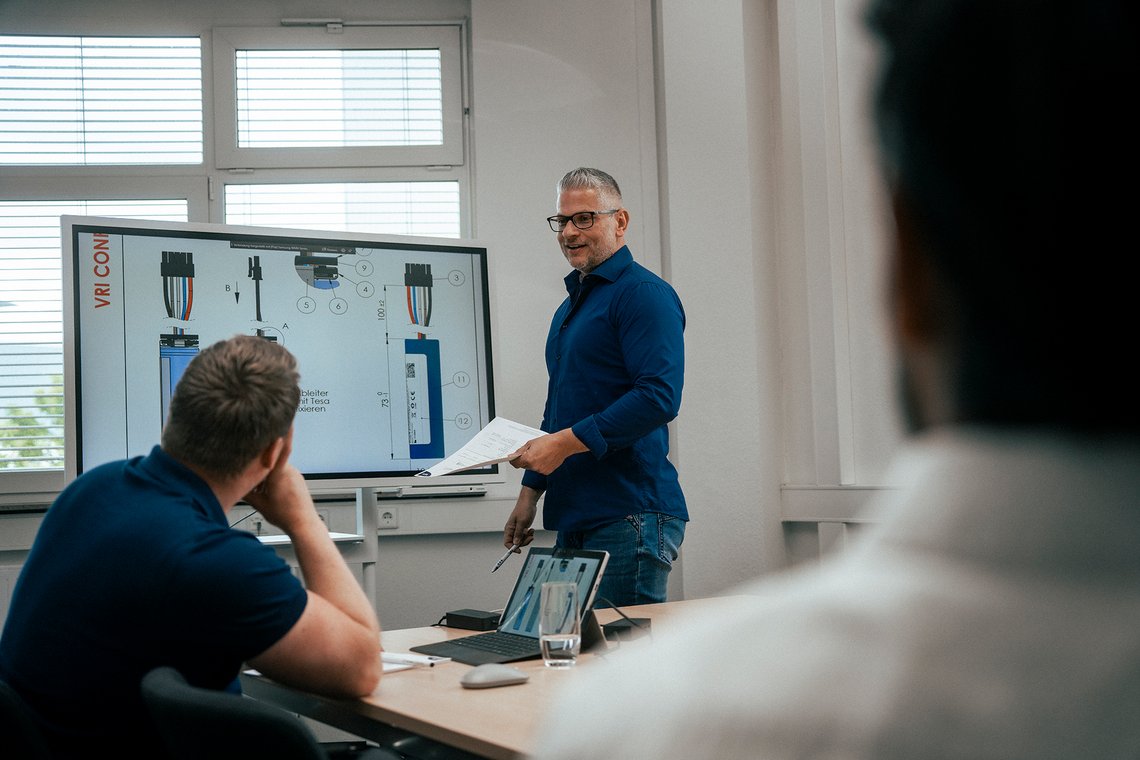
Climate protection training at VRI – engaging employees in sustainable battery development and battery systems expertise
Successful climate protection can only be achieved through the involvement of management, executives, and the active participation of all employees. Climate protection must be lived at VRI, not merely administered.
Measures:
- Regular information for all employees on climate protection targets, progress, and measures.
- Engagement of employees through surveys, workshops, and idea competitions (building on the Klimafit employee survey).
- Training and awareness-raising on the topic of climate protection in daily work (saving energy, waste separation, climate-friendly mobility).
- Promotion of a corporate culture in which climate protection is understood as a shared responsibility.
- Recognition and appreciation of employee engagement in climate protection.
Organization and responsibilities
| Role | Task and responsibility |
|---|---|
| Managing Director (Ralf Isermeyer) | Bears overall responsibility for the implementation of the climate protection guidelines and provides the necessary resources. |
| Climate Protection Officer (Ralf Isermeyer) | Acts as point of contact, data collector, and controller. Coordinates the implementation of measures and reports regularly to the Managing Director. |
| All employees | Contribute to achieving the climate targets through their day-to-day actions. |
Our contribution to the energy transition
As a manufacturer of battery systems, we are part of the solution. Our products enable the storage of renewable energy, the electrification of mobility and industry, and the operation of autonomous systems — from automated guided vehicles to medical technology. We aim to further expand this positive contribution while ensuring that our own value creation is as climate-friendly as possible.
In doing so, we orient ourselves toward the climate targets of the German Federal Government (climate neutrality by 2045), the targets of the State of Baden-Württemberg, and SDG 13 (Climate Action) of the United Nations.
Scope and contact
Scope
These climate protection guidelines apply to the Ellwangen (Jagst) site, Wilhelm-Maybach-Straße 4, and cover all business areas of VRI GmbH Batterie-Technik — administration, development, production, and logistics.
Responsible
VRI GmbH Batterie-Technik
Wilhelm-Maybach-Straße 4
73479 Ellwangen (Jagst)
Managing Director: Ralf Isermeyer
Purpose: These climate protection guidelines are a voluntary commitment of VRI GmbH Batterie-Technik. They describe our framework for operational climate protection and replace neither statutory requirements nor binding certification standards.
Source: Prepared as part of participation in the Klimafit Baden-Württemberg programme, Region Ostwürttemberg. The programme is funded by the Ministry of the Environment, Climate and Energy Management of Baden-Württemberg and supported by CMC Sustainability GmbH. The accounting methodology is based on the Greenhouse Gas Protocol.
Last Updated | Basis | Source: March 2026 | First edition v1.0 | Klimafit BW / CMC Sustainability GmbH. These guidelines are reviewed at least every two years and will be supplemented with specific reduction targets (Chapter 4.2) after completion of the first greenhouse gas inventory.